Articles
Why Branding Is an Investment in Your Company’s Future
Feb 10th 2026
Branding is either building leverage for your company — or quietly limiting it. Most people don’t realize which side they’re on. This article might help you find out...

“We just need a logo.”
We’ve heard that sentence more times than we can count. It usually comes right after someone opens a spreadsheet and tries to “optimize” the budget. Branding gets grouped with design, and design gets grouped with “nice to have.” But here’s the uncomfortable truth:
Branding is not a cost line in your budget. It’s a multiplier—or a liability.
When you treat branding as decoration, you underfund it. When you treat it as strategy, it becomes one of the most powerful assets your company owns.
Let’s unpack why.
What We Actually Mean When We Say “Branding Is an Investment”
An expense is something you consume.
An investment is something you put money into expecting future return.
Rent is an expense.
Infrastructure is an investment.
So where does branding sit?
If branding is just a logo file and a color palette, then yes — it’s an expense. You pay for it, you receive it, and that’s the end of the story. But real branding is not a file. It’s a system. It includes:
Positioning
Messaging
Visual identity
Verbal tone
Guidelines
Consistency across touchpoints
And most importantly, it builds brand equity.
Brand equity is the accumulated value of how people perceive you. It’s the mental availability, trust, associations, and reputation attached to your name. And equity does not disappear after payment. It compounds.
An expense disappears. An investment compounds.
Branding, when done properly, creates long-term return through recognition, trust, differentiation, and pricing power. It shapes how your company is remembered — and how easily it is chosen. That’s not decoration. That’s infrastructure.

The Real Returns of Investing in Branding
If branding is an investment, what exactly is the return?
Let’s make it concrete.
1. Pricing Power
Strong brands compete less on price.
When your positioning is clear and your identity is cohesive, your perceived value increases. And perceived value is what customers actually pay for.
This is not about hype. It’s about differentiation.
When your brand communicates:
Who you are
Who you’re for
Why you’re different
You stop being interchangeable.
And when you’re not interchangeable, you don’t have to race to the bottom.
Branding gives you leverage. And leverage protects margins.
2. Trust and Reduced Friction
People choose what feels safe.
A cohesive brand system — consistent visuals, tone, and messaging — increases what psychologists call cognitive fluency. When something is easy to process, it feels more trustworthy.
If your website says one thing, your Instagram another, and your packaging something else, friction increases. Doubt creeps in.
But when everything feels aligned? The decision becomes easier. Good branding reduces the mental effort required to choose you. That reduction in friction translates into higher conversion and stronger loyalty over time.
3. Strategic Clarity
Branding is not just external. It aligns your company internally.
When your positioning is clear:
Marketing becomes more focused.
Sales arguments become sharper.
Hiring becomes more intentional.
Partnerships become more aligned.
Without branding strategy, every campaign becomes a mini identity crisis.
You change colors.
You shift tone.
You test random taglines.
And slowly, you dilute your own message. Branding gives your company a center of gravity. It tells everyone — internally and externally — what you stand for and how you show up.
4. Long-Term Recognition
Recognition is not built overnight.
It is built through repetition and consistency.
In branding theory, we often talk about distinctive assets — visual and verbal elements that make a brand recognizable: a specific color system, typography style, tone of voice, iconography, or even a way of structuring headlines.
When those assets are used consistently across time and channels, they build memory structures in your audience’s mind.
And memory drives choice.
The more recognizable you become, the less you need to shout.
That’s the compounding effect of branding.
The Hidden Cost of Treating Branding as an Expense
Now let’s flip it. What happens when branding is treated as a “one-time cost”?
You hire the cheapest option.
You skip strategy.
You get a logo.
You move on.
At first, nothing seems wrong. But then:
You redesign your website two years later.
You “refresh” your identity because it feels outdated.
Your social media looks disconnected from your packaging.
Your ads don’t convert because the positioning isn’t clear.
And you start paying again. And again. And again.
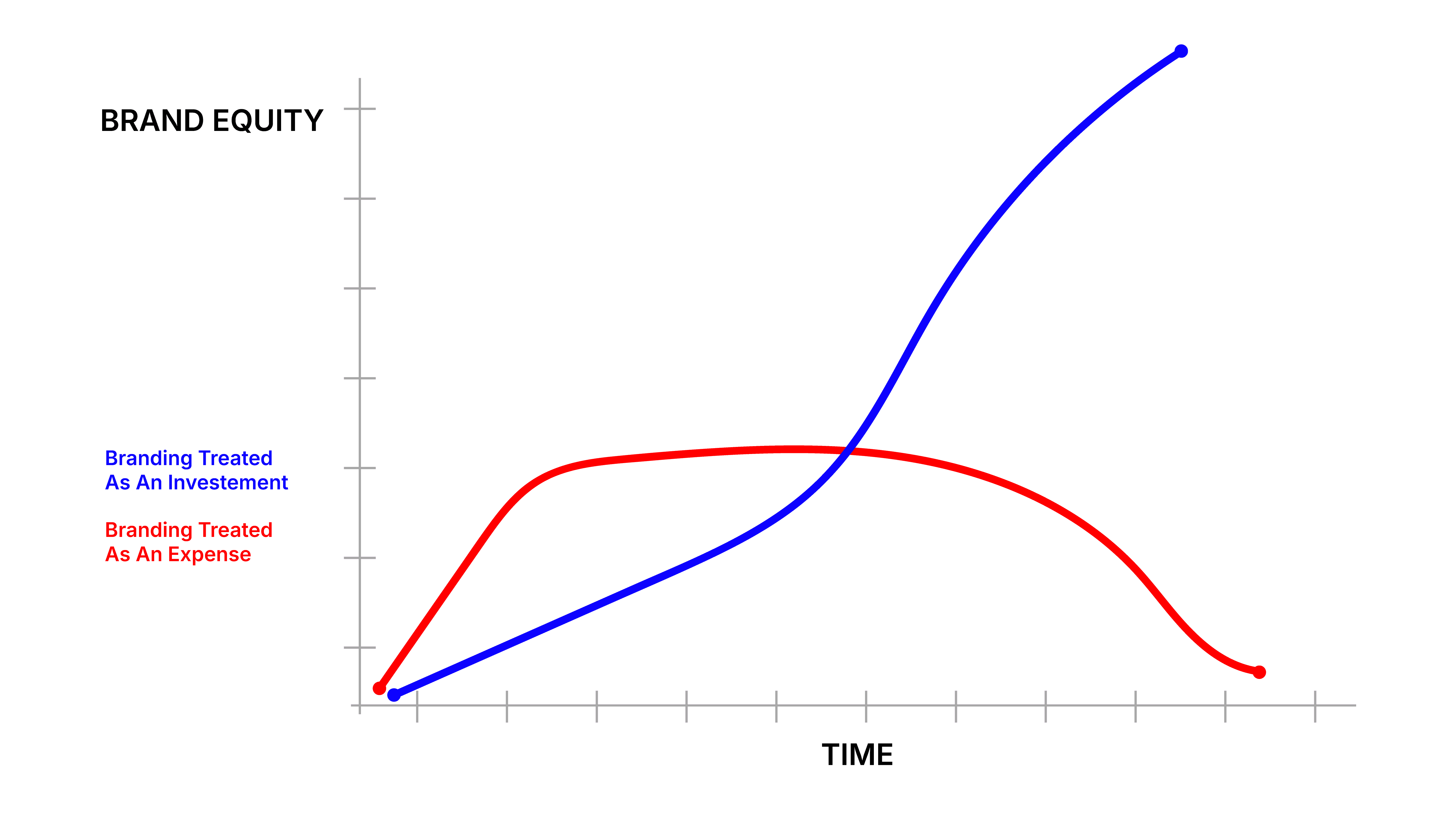
The real cost of weak branding is not the invoice. It’s:
Inconsistent execution
Confused audiences
Lower perceived value
Constant rework
Price pressure
Internal chaos
You always pay for branding. The only question is whether you pay upfront — or in penalties later.
When branding lacks strategic depth, you compensate with more marketing spend, more redesigns, more discounts. That’s not saving money. That’s leaking it.
Branding Is a Long-Term Decision About the Company You Want to Become
Here’s the real shift. Branding is not about how you look today. It’s about who you are building toward.
If you want:
Higher margins
Stronger authority in your category
Long-term relevance
Internal alignment
A company that outlives trends
Then branding cannot be treated as decoration. It must be treated as strategy. This does not mean “spend more blindly.”
It means:
Think long-term.
Invest in clarity.
Build systems, not isolated assets.
Work with people who understand positioning, not just visuals.

Good branding is not expensive because of aesthetics. It is valuable because it creates leverage. And leverage compounds.
If you want short-term noise, treat branding as an expense.
If you want long-term value, treat it like the asset it is.
And if you’re serious about building something that lasts, then investing in branding is not a luxury. It’s a responsibility.