Articles
The Celebrity Brand Illusion
Aug 21st 2025
Kardashian, Chamberlain, Robegrill—a famous name can make anything go viral. But can it make it profitable?
From IG Likes To Grocery Aisles
It’s 2025, and celebrity side hustles are everywhere. Food products dreamt up by YouTubers, mayo jars stamped with cookbook authors, shapewear turned into billion‑dollar empires, even tacos hyped by Instagrammers who treat three‑hour lines like bragging rights. Fame has become the shortcut button for CPG—why grind when you can skip straight to shelf space at Target?
But here’s the fun part: once the launch buzz dies, the filters fade, and TikTok moves on, the real test begins. That’s where branding either holds the fort or collapses under its own glitter. This isn’t a story about who slapped their name on what—it’s about whether the design, the storytelling, and the product itself have enough bite to survive after the hype hangover. Buckle up—we’re about to dig into some of the most gloriously messy, occasionally brilliant, and always telling examples of celebrity brands today.*
Chamberlain Coffee: Cute Design, Bitter Aftertaste
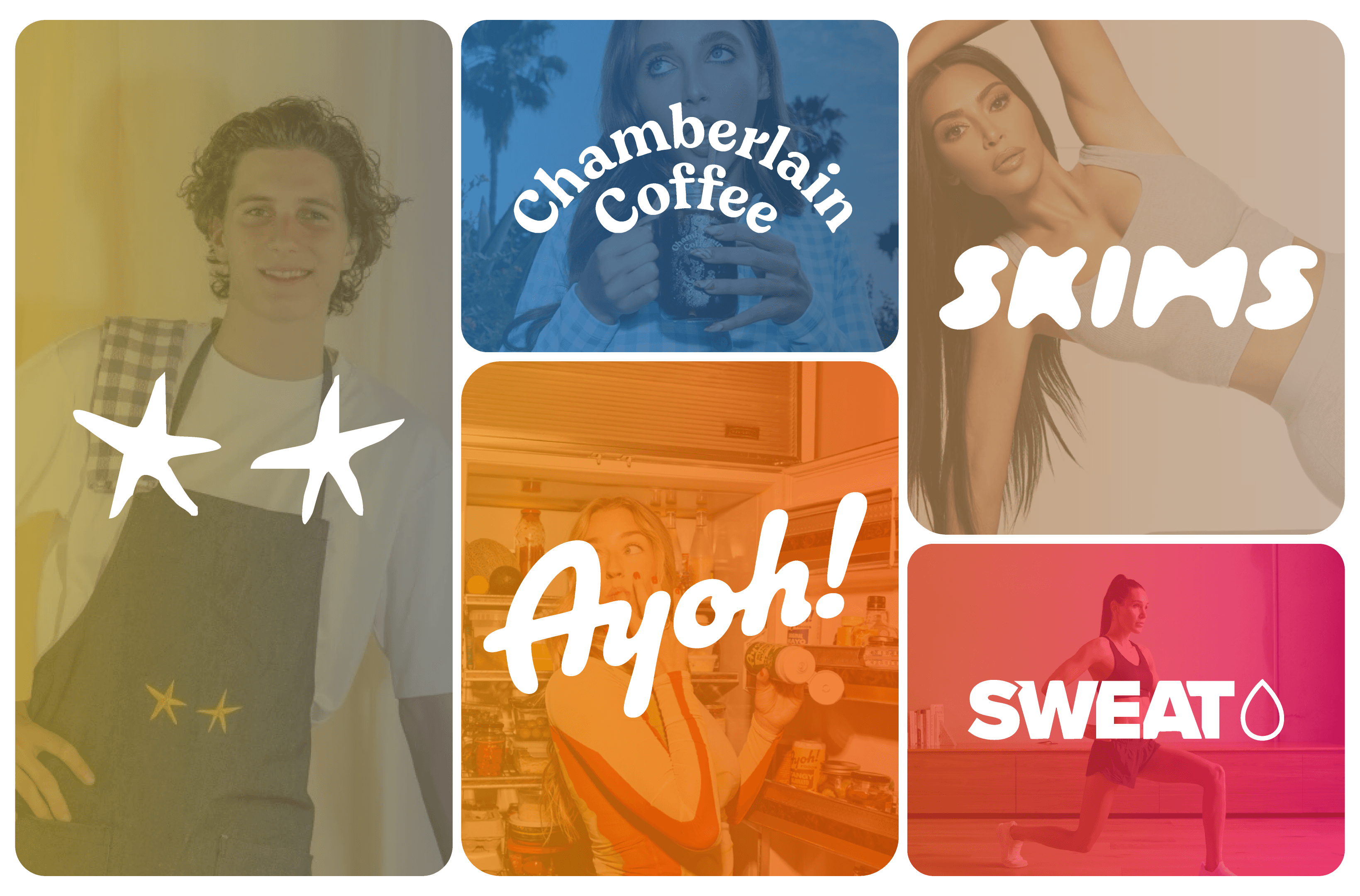
Emma Chamberlain spun her Gen Z relatability into Chamberlain Coffee, with branding that flipped the elitism of specialty coffee. No intimidating tasting notes, no matte-black minimalism—just colorful cartoons and approachable vibes. It took the joyless ritual away from the gatekeeping coffee nerds who argue about grind size like it’s geopolitics. It democratized a snobby product. And that’s a good thing for the world, honestly. Anything that takes power away from coffee snobs policing pour-overs like FBI inspectors, is positive.

Typography, however, flirts dangerously close to Chobani’s soft, rounded serifs—a déjà vu moment that makes us wonder: is it intentional homage or lazy borrowing? Combined with the “Ch-” name similarity, the design feels slightly derivative, though effective in lowering the intimidation factor. Cute, yes. Original, not so much.
The numbers impressed: $20M in revenue in 2023 (Forbes), but Sprudge notes $22M in revenue paired with operating losses the following year. Add mixed reviews—“cute can, meh taste”—and you have a branding case study in how visuals can’t carry weak flavor forever. Because here’s the thing: no matter how many doodles you slap on a bag of beans, bad coffee is still bad coffee.

Ayoh!: When Your Obsession Becomes Everyone’s Sandwich
Molly Baz’s Ayoh! swerved past beauty clichés and went all in on mayo. Framed as “Sando Sauce,” it leans into bold typography, loud blocks of saturated color, and squeezable packaging that screams convenience and cultural relevance. Where Chamberlain played it safe, Ayoh! is maximalist and proud.

There’s real semiotic cleverness here: the logo’s chunky letterforms mimic mayo blobs, while flavor-specific palettes telegraph personality at a glance. The photography is rich, cheeky, and a little chaotic—more Bon Appétit on acid than Kraft Foods. The result? A brand that not only looks different, but feels like it has a pulse. It’s mayo, but make it fashion—and honestly, it’s some of the best CPG branding we’ve seen in years.
The product backs it up: 170,000 bottles sold, national Whole Foods distribution, and flavors that actually taste good (rare in celebrity CPG land). Consumers didn’t just buy once—they evangelized. Because here’s the secret sauce: Molly isn’t moonlighting in skincare or booze—she’s a chef geeking out on condiments. When celebs build in their own lane, the branding doesn’t have to cover cracks, it amplifies credibility. Imagine that: a celebrity brand with a product you’d actually want to rebuy—because it’s both fun and legit.

Skims: The Billion-Dollar Neutral Palette
Kim Kardashian’s Skims plays a different game. Designed by King & Partners, the brand is architected around tonal restraint: muted palettes, minimalist typography, photography lit to feel like natural skin. It’s basically brand language syncing up with cultural vibes. Where many apparel startups over-design, Skims strips back to let the product (and bodies) take the spotlight.

The results are staggering: $750M revenue in 2023, $190M profit, $4B valuation (Sacra, NYT). But beyond numbers, the genius lies in diversification. Campaigns aren’t just Kim—Skims pulls in Post Malone for the bros, Usher for the millennials, athletes for the sports crowd, and rising actresses for Gen Z. It’s a buffet of relevance, embedding itself into culture way beyond Kim’s orbit. And the drop-style launches? Straight out of sneakerhead playbooks: scarcity + hype = loyalty (and empty wallets).

Restraint, inclusivity, cultural saturation: Skims proves that when branding aligns with product reality, you can turn spandex into empire. Kardashian fame kicked the door off its hinges, but it’s the brand’s day-to-day hustle that kept the lights on (and the cash register cha-chinging).
Sweat: Proof That Substance Outlives Aesthetic
Kayla Itsines’ Sweat app is the outlier here. The branding is functional, even generic—pink reddish highlights, bubbly typefaces, UI that feels straight out of a Figma starter kit. Nothing revolutionary.

But here’s the twist: it doesn’t matter. Sweat thrives because the experience design—not just the visuals—delivers. Users don’t log in for typographic hierarchy; they log in for results. And the app’s structure, progression systems, and community-building elements give them exactly that. It’s branding by outcome.
It’s almost refreshing: a celebrity brand that proves sometimes you don’t need fireworks. Mediocre visuals, excellent UX, glowing reviews—Sweat wins because it sweats the details that matter.

Tacos París: The Pop-Up Formula
Robegrill and Chema Martínez’s Tacos París is branding as theater. Three-hour lines, $120 tacos (2X-3X the average price of a taco), and minimal design. The identity isn’t in the typography or signage—it’s in the scarcity. People don’t queue because the logo is beautiful; they queue because FOMO is.
And here’s the smart part: the scarcity is the branding. They’ve hacked the influencer economy by turning tacos into an event, not just a meal. A pop-up like this doesn’t need ornate logos because the design language is the line itself, the buzz, the Instagram tags. That’s intentional and clever.

Of course, pop-ups are by nature temporary, and some reviews point to service hiccups. But as a tactic, it’s effective: scarcity creates urgency, and urgency creates hype. In that sense, Tacos París is a reminder that design isn’t always ink on paper—it can be strategy served on a tortilla, or the bill...
Checkout
Celebrity gives you the stage. Branding writes the script. Product earns the encore.
Chamberlain Coffee shows the limits of cuteness when taste disappoints. Ayoh! proves originality and expertise scale authenticity into obsession. Skims demonstrates restraint as a radical branding move, paired with cultural saturation. Sweat reveals that functional UX is design, even if the visuals don’t wow. And Tacos París? It’s FOMO-as-branding, destined to fade unless operational excellence steps in.
The pattern is clear: fame is a launchpad, not a parachute. Design is more than decoration—it’s strategy, architecture, and trust. And when those pieces align with genuine product value, celebrity brands can transcend novelty and carve real cultural impact. And here’s another truth: when you mix what you genuinely love with what you actually know (and are good at), your odds of success skyrocket. Molly Baz loves sandwiches and knows food—boom, Ayoh! works. Kim knows media and branding—Skims explodes. When celebs step outside their lane, the cracks show faster than a bad latte art pour.
P.S. Coffee nerds, don’t @ us—we like fun packaging more than your $500 grinder.