Articles
You’ve Seen Pixel Street Art in Paris. Here’s What It Really Means...
Feb 13th 2026
Those pixel mosaics scattered across Paris aren’t random decoration — they’re part of one of the most coherent visual systems in contemporary street art.

You’re walking through Paris. Cream stone façades, wrought‑iron balconies, Haussmann symmetry. And then, just above a street sign, you spot it: a small, blocky alien made of colored tiles.
You might not know the artist’s name yet. You might even Google something like pixel street art Paris to figure out what you just saw. But whether you know it or not, you’ve just stepped into one of the most coherent visual ecosystems built in modern urban art.
And to understand why these tiny figures matter, we first need to understand who put them there.
Who Is Behind the Pixel Street Art in Paris?
The artist behind these mosaics is known as Invader — an anonymous French street artist who began installing tile works in Paris in the late 1990s.
His idea was simple and radical at the same time: take the 8‑bit characters of early arcade games — especially the iconic Space Invaders — and translate them into physical space using ceramic tiles.
Instead of spray paint, he uses square tiles. Instead of tags or letterforms, he builds pixelated figures. It is, in many ways, his version of graffiti.
Traditional graffiti relies on gesture, speed, and fluid lines. Invader relies on grids, modules, and pre‑planned compositions. One is improvised calligraphy; the other is modular construction. Both occupy the city. Both claim space. But the visual logic is completely different.
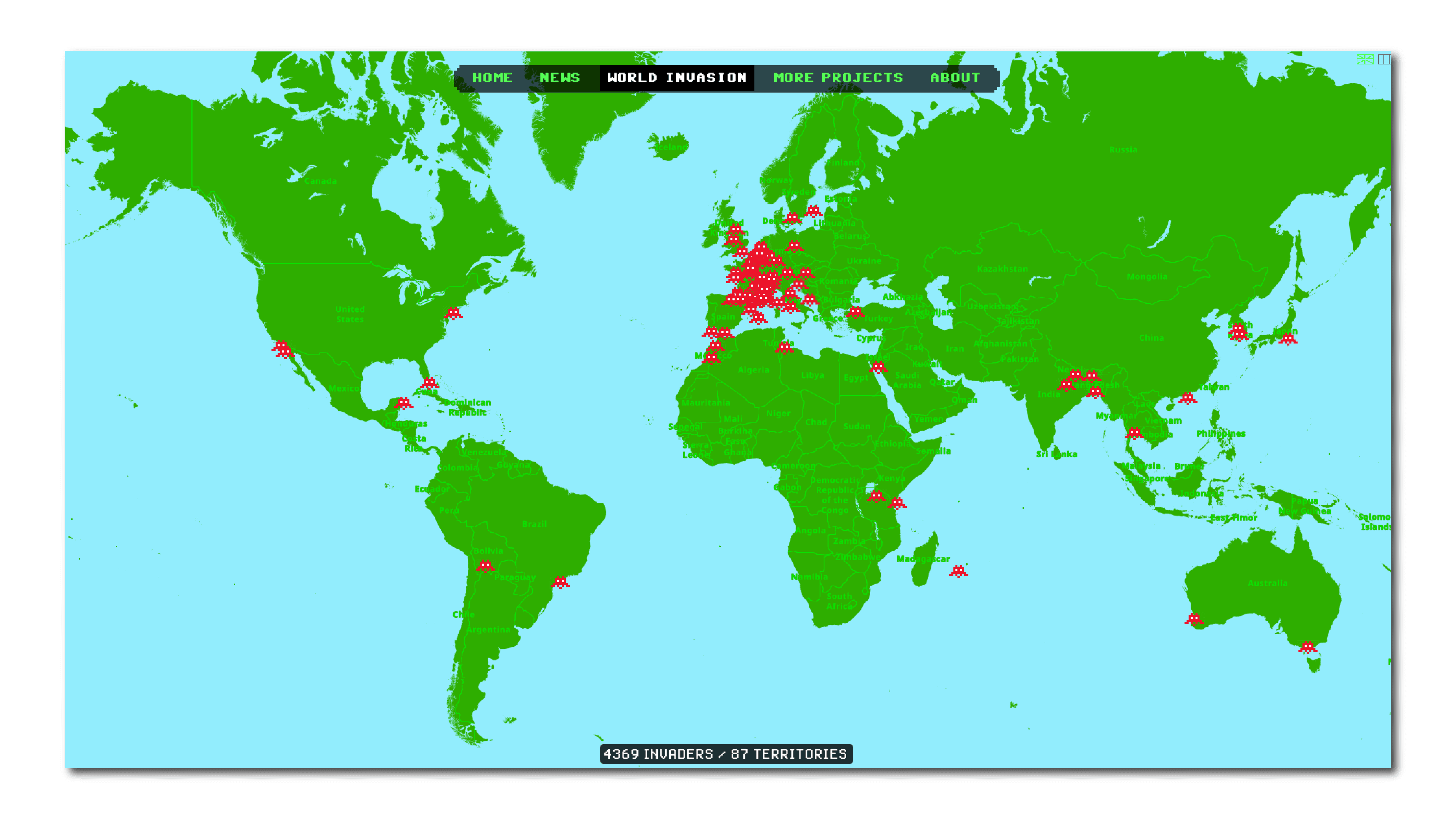
Paris became his main playground. Over the years, hundreds of mosaics have appeared across the city — from small aliens tucked high above doorways to larger installations referencing pop culture icons like Bugs Bunny or even reinterpretations of the Mona Lisa in pixel form.
Although his “invasions” have expanded to cities like London, New York, and Tokyo, Paris remains the densest and most layered chapter of the project. The city functions almost like the central hub of his universe.
And that word — universe — is important. Because once we look past the biography, the real story begins with the system behind the tiles.
From Video Game Pixels to Ceramic Tiles: Why the Grid Matters (Design-Wise)
Let’s step away from Paris for a moment and look at this through a design lens. At the core of Invader’s work is a grid system.
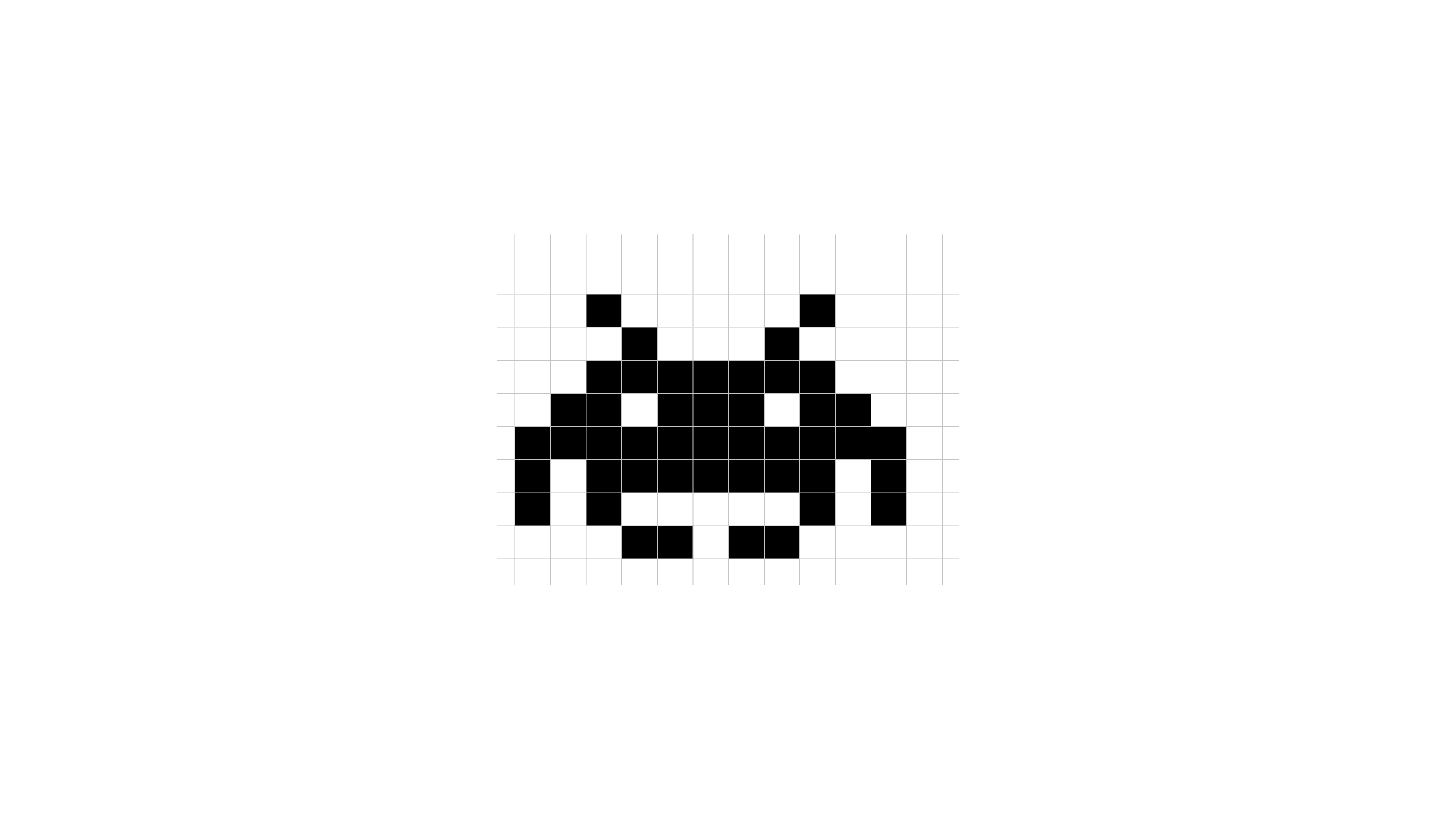
A pixel is simply a square unit in a digital grid. Early video games were constrained by low resolution, meaning characters had to be built from a very small number of squares. That limitation forced designers to think carefully about silhouette, contrast, and color.
Invader translates that digital logic into physical space:
One tile = one pixel
A wall = a canvas grid
A character = a modular composition
This is grid-based design in its most literal form. And grid systems are not just for posters or web layouts. They are frameworks that bring order, consistency, and scalability to visual work. Because the resolution is limited, every square matters. There is no room for unnecessary detail. The figure must be readable from a distance, often in just a few colors.
This is where constraint becomes powerful. When you limit:
Resolution
Color palette
Shape language
you force clarity.
The result? Strong silhouettes. Immediate recognizability. Visual consistency across hundreds of pieces. For designers, this is a reminder that systems outperform decoration. A clear modular logic will always scale better than endless improvisation.
But the grid alone doesn’t explain the cultural impact — for that, we need to look at how the project is structured.
The “Invasion” System: Turning Street Art into a Universe
What makes pixel street art in Paris especially fascinating is not just the aesthetic — it’s the structure behind it.
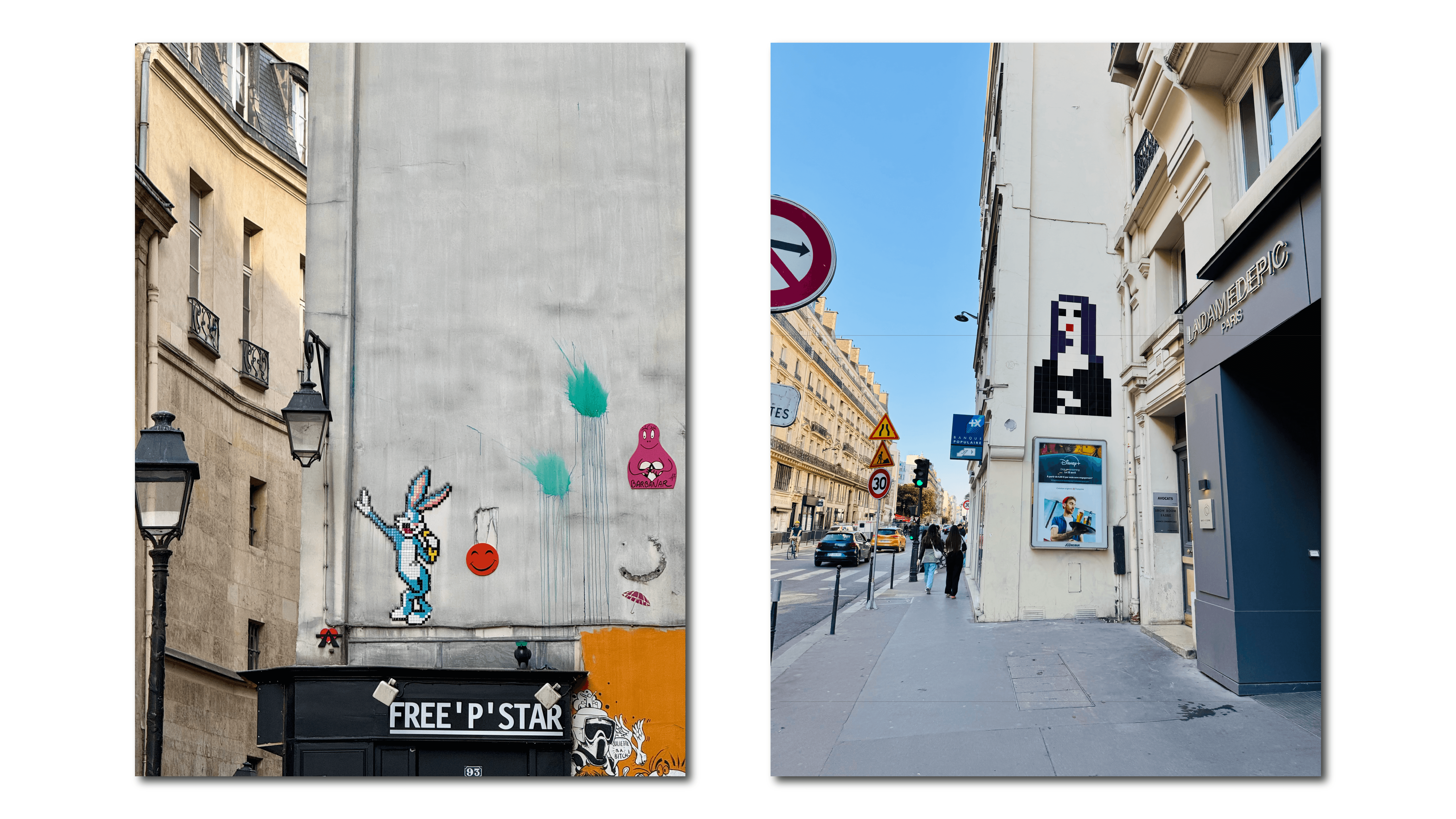
Invader doesn’t simply install random mosaics. He frames each city as an “invasion.” Every piece is catalogued and numbered. Paris is one invasion among many, but also the most extensive. Over time, this evolved into something bigger than street art: a world.
There are maps documenting where works are located. There is a scoring system. There is even an app — Flash Invaders — where people can “collect” mosaics by photographing them. Each piece has a point value. This is gamification layered onto urban art.
From a design perspective, several important principles are at play:
1. Repetition with variation
The core motif (pixel character) stays consistent, while themes and references change.
2. Series logic
The works function as chapters within a larger collection.
3. Worldbuilding
There is a narrative frame (“invasion”) that connects everything.
This is not just art on walls. It’s system thinking applied to culture.
When designers talk about creating ecosystems instead of isolated outputs, this is what we mean. A logo alone is not a brand. A poster alone is not a campaign. A mosaic alone is not the project. The power comes from coherence over time.
We see similar ecosystem thinking in other creative fields. For example, in our article about Matty Matheson, we explored how he builds a consistent visual and cultural universe around food, personality, typography, and merchandise. Different medium, same principle: a clear identity extended across platforms.
The lesson is simple: when everything connects, the impact multiplies. And once you see the project as a universe, you start noticing how even the smallest pieces are carefully designed for impact.
Why These Tiny Mosaics Feel So Powerful
Most Invader works are not monumental. Many are small. You can walk past one without noticing it. And yet, once you start seeing them, you cannot unsee them. Why? Let’s break it down visually.
Contrast
Parisian architecture often features light stone façades. Bright ceramic tiles in high contrast colors stand out immediately.
Figure/ground clarity
The pixel characters are clean silhouettes. Gestalt principles — especially figure/ground separation — make them easy to process quickly.
Legibility at distance
Because they are built from simple square units, the shapes remain readable from far away. No fine detail gets lost.
Strategic placement
They are often placed at corners, above signs, or along architectural lines — locations that naturally attract the eye.
In terms of visual hierarchy, they interrupt the environment just enough to become memorable without overwhelming it. This is an important design insight: scale does not determine impact. Clarity does. A tiny, well-structured form can outperform a massive but chaotic one.
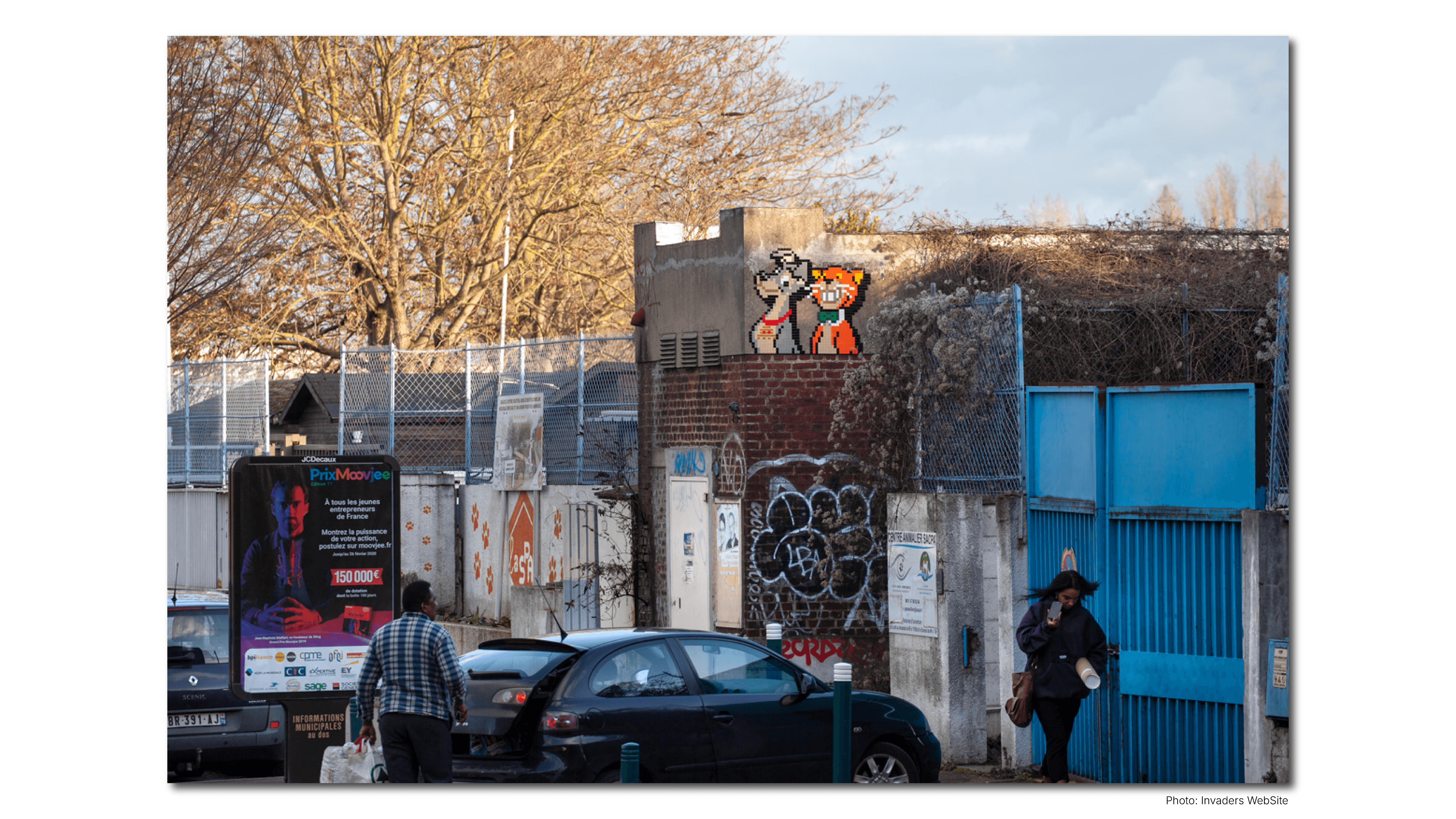
We also see variation in scale. Some installations are larger and more elaborate — including pixel versions of cultural icons like Bugs Bunny or the Mona Lisa. These pieces demonstrate how the same grid logic can scale up while maintaining identity.
Again, system over spontaneity. And when we connect clarity, system, and long-term repetition, the real design lessons begin to surface.
What Designers Can Learn from Pixel Street Art in Paris
So what does all this mean for us as designers? First, consistency is not boring — it is strategic.
Invader has been working within the same visual language for decades. He did not reinvent himself every year. He refined a system and expanded it.
Second, constraints sharpen identity. Limited colors. Square modules. Recognizable silhouettes. These restrictions create cohesion. In branding and digital design, constraints are not limitations — they are guardrails.
Third, build ecosystems, not isolated pieces. The mosaics, the maps, the numbering, the app, the global invasions — together they form a connected world. This is how long-term recognition is built.
Fourth, medium matters. By choosing tiles instead of spray paint, Invader positioned himself differently within the street art landscape. The material choice reinforces the pixel concept. Form and concept align.
Finally, think long-term. Pixel street art in Paris is compelling not just because of individual pieces, but because of accumulation. Over time, repetition becomes memory. Memory becomes cultural presence.
As designers, whether we are building brands, digital platforms, or visual identities, the same principle applies: design systems create durability.
If we want our work to last, we should think less about the next trendy execution and more about the structure that holds everything together.
And maybe next time you’re in Paris and you look up at a small pixel alien, you won’t just see street art. You’ll see a grid. A system. A world.